Why Tennis Keeps Its Own Vocabulary
Why tennis keeps its own vocabulary: learn scoring calls, court terms, and match customs so you can follow play and join a local game with confidence.
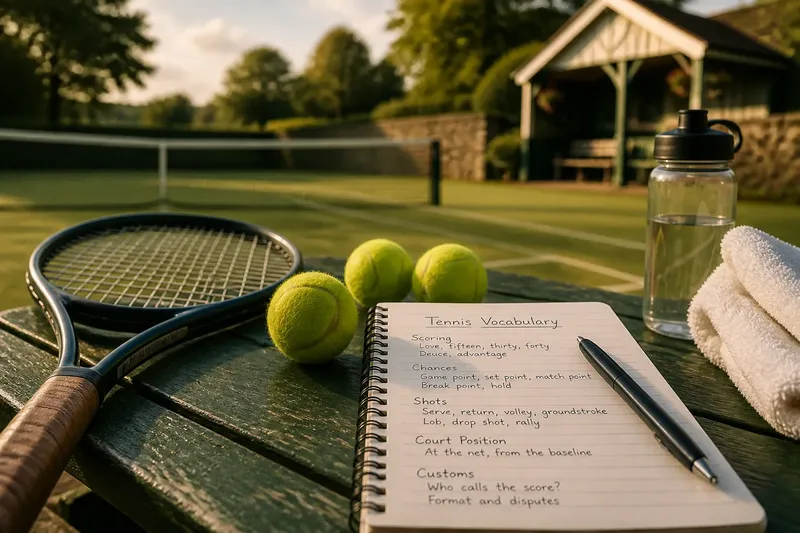
The most common mistake in tennis vocabulary is treating every unfamiliar call as a score. That can make a simple announcement sound like a mystery and leave you unsure whether the point, game, or match has changed. Tennis vocabulary helps you follow the action and speak comfortably on a club court, village court, or open-air ground.
Point and game calls
A tennis game uses love, fifteen, thirty, and forty rather than an ordinary count. Love means zero; “thirty-love” means one player has two points and the other has none. The server’s score is usually called first, so “thirty-fifteen” gives the server’s score before the receiver’s.
At forty-all, the score is called deuce in advantage scoring. The next point gives one player advantage; if that player wins the following point, the game ends, but if the opponent wins it, the score returns to deuce. Some casual formats use a different rule, so players should agree on it before beginning.
A game is one layer of the score: games make up a set, and sets make up a match. Keeping those terms distinct prevents a call about a game from sounding like a declaration that the whole match is over.
Terms for chances
Game point, set point, and match point describe what a player could win on the next point. They name an opportunity, not a result: a player can save a match point, and a set point can pass without ending the set.
A break point is a chance for the receiver to win the game against the server. If the server wins that game instead, it is a hold; if the receiver wins it, the receiver has broken serve. These terms tell you what the result means for the match, not which shot a player must choose.
Say you are watching a game at a village court and hear “break point” while the receiver is waiting to return. You know the receiver can win the game on this point; if the server wins it, the game continues or ends according to the score, and the receiver has not yet made a break. That distinction keeps possibility separate from outcome.
Shots and court language
Other tennis terms describe how a rally unfolds. A serve starts the point, and a return is the shot played against it. A volley is hit before the ball bounces; a groundstroke is hit after a bounce.
A lob sends the ball high over an opponent who is near the net, while a drop shot is played softly so it lands close to the net on the other side. A rally is the exchange of shots after the serve. Knowing these words makes a player’s or commentator’s description easier to picture without needing to infer the score.
“At the net” and “from the baseline” describe court position, not a scoring advantage. The same shot can be a sensible choice or a risky one depending on where both players stand, so listen for the position before assuming what a phrase says about the point.
Customs and calls
On a court without a chair umpire, players often call the score themselves. In a formal match, an umpire makes the calls for players and spectators. In either setting, a clear announcement helps everyone know the score before the next point.
Players should also know how the group handles a disputed call or a format variation. If you are joining a casual match, ask who will call the score and what rule applies after deuce. That brief exchange is more useful than assuming every court follows the same arrangement.
Imagine you arrive at an open-air court and two friends say they are playing a deciding point at deuce. You ask whether they use advantage scoring or a single deciding point; they say advantage, so you expect the score to return to deuce if the player with advantage loses the next point. You can then follow the calls without interrupting play or treating the first point after deuce as an automatic finish.
Which terms help first?
How do you follow a spoken score?
Listen for the server’s score first, then the receiver’s, and recognize love as zero. If you hear “forty-all,” the game is tied; the agreed format determines what happens next.
What does a break point mean?
It means the receiver can win the game on the next point. If the server wins that point, the receiver has not broken serve, and play continues according to the score.
What is the difference between a volley and a groundstroke?
A volley is struck before the ball bounces, while a groundstroke follows a bounce. These names describe the shot, not the score or the outcome of the rally.
What should newcomers ask before a casual match?
Ask who will call the score, what format the players are using, and how they handle uncertain line calls. The answers clarify the local routine before a disputed moment interrupts play.
A court-side checklist
Use these observations to decide what a call means or what to ask next:
- Check whether the call includes love; if it does, read it as zero for that player, then follow the score as announced.
- Check whether the score is forty-all; if it is, ask or recall whether the group uses advantage scoring, then expect either advantage or its agreed alternative.
- Check whether you hear game point, set point, or match point; if you do, treat it as a chance to finish that level, not proof that it has ended.
- Check who is serving when break point is called; if the receiver can win the game on the point, follow the result as a possible break, and if the server wins, continue with the current score.
- Check whether the ball bounced before the shot; if it did, the shot may be a groundstroke, and if it did not, it may be a volley.
- Check who is calling the score and whether everyone can hear; if the call is unclear, ask for it to be repeated before the next point rather than guessing.
Questions about tennis terms?
Why does tennis say love?
Love means zero in a tennis point score. Its exact origin is uncertain enough that you can learn the meaning without relying on a particular origin story.
What happens after deuce?
In advantage scoring, the next point gives one player advantage. That player must win the following point to take the game; otherwise, the score returns to deuce.
Are tennis terms the same on every court?
Many terms are widely understood, but casual groups may agree on different scoring formats or call routines. Ask the players or event organizer which rules apply before play.
Putting the words together
When you hear a tennis term, ask whether it names a score, a chance, a shot, or a court position. That quick distinction helps you follow the point without confusing a possible result with one that has already happened.
Tennis vocabulary is easier to use when it serves the people sharing the court. Learn the common calls, check local customs when needed, and leave room for the rally itself to supply the rest.